Smart Window
Team Lead
I led a team of five to build an automated window that opens and closes itself based on temperature and air quality on both sides, replacing AC use when outdoor air is cooler or cleaner. I handled the mechanical design and fabrication, including a chain and sprocket drive salvaged from a discarded bicycle (chosen for the project's sustainability theme over a fresh belt or lead screw). The hardest part was integration, since getting chain tension, motor torque, sensor thresholds, and frame tolerances all working together was harder than any subsystem on its own. We presented at the CU Boulder Engineering Exposition and won Most Impactful out of 200+ projects.
The Concept
AC accounts for a huge share of residential energy consumption, and a lot of it is wasted. I started thinking about this after watching a video about how ancient cultures kept buildings cool without any powered systems; Persian wind catchers (bâdgirs) channeled breezes through buildings, and yakhchāls stored ice through the summer using thick walls and evaporative cooling. The core idea is simple: if outdoor air is cooler than indoor air, or outdoor air quality is better than indoor, you should be using it instead of running the AC.
I led a team of five to build a window that does this automatically, monitoring temperature and particulate matter on both sides and opening or closing itself to optimize natural ventilation. I handled the mechanical design and fabrication with one teammate, assigned two others to the electronics, and kept the fifth member as a floating assistant. We had a $300 budget and a couple months to build a working prototype. The guiding principle was sustainability, both in what the window does (reducing HVAC energy consumption) and how we built it (recycled components where possible). The prototype is about 29 inches square; essentially a miniature window assembly we built to test the full concept end to end.
Drive Mechanism

A chain and sprocket system drives the window open and closed. The chain runs horizontally along the frame bottom, powered by a NEMA 23 stepper motor on one end with an idler sprocket on the other. Laser cut finger joints in the acrylic window mesh directly with the chain links, converting rotational motion to smooth linear translation.
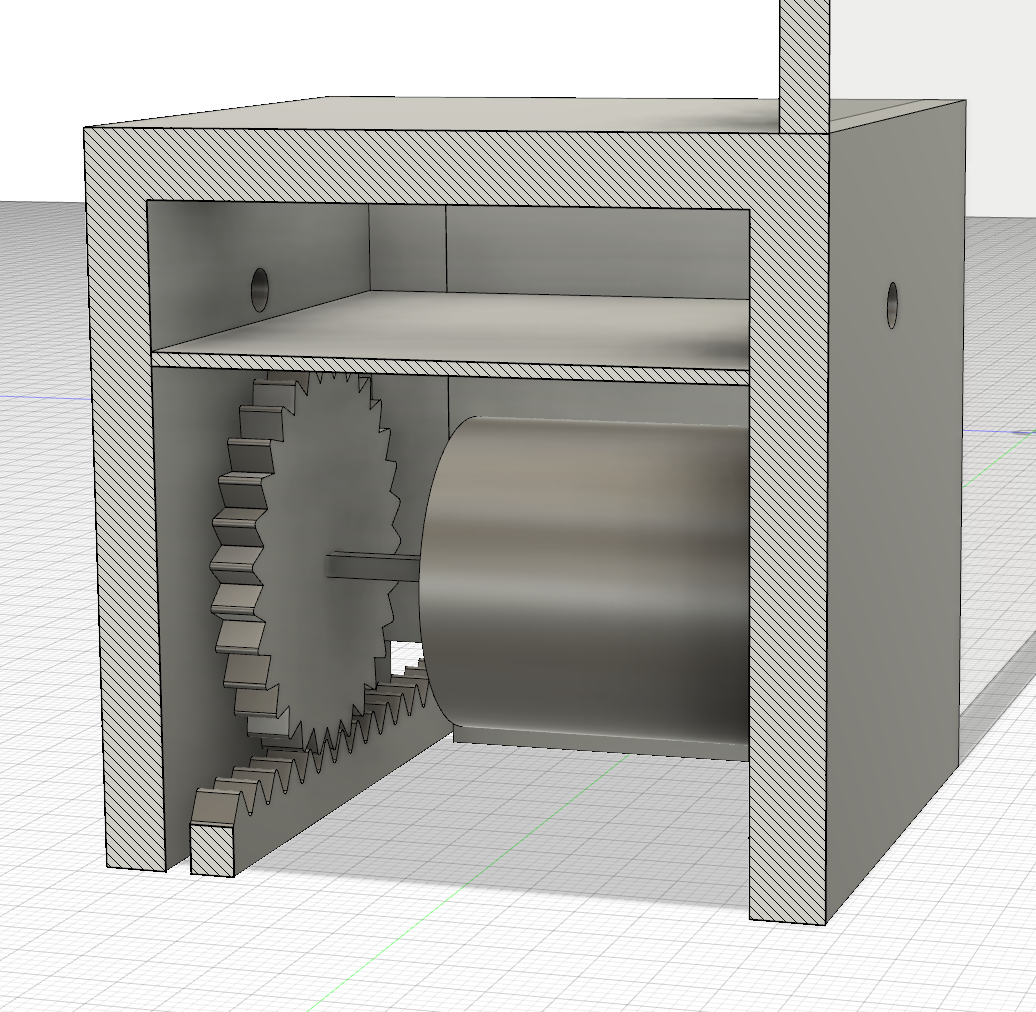
I initially prototyped a 3D printed gear and rack system, but applying torque at a single corner caused binding. When it came time to pick a replacement, the sustainability focus of the project pointed me toward something recyclable. I salvaged sprockets and chain from a discarded bicycle, which gave us reliable, proven hardware for free while staying true to the project's ethos. A belt drive would have worked but belts slip under load; a lead screw would have been precise but wasn't a recycled option. I 3D printed a custom adapter to mount the sprocket directly to the motor shaft. Getting proper chain tension took some iteration; too loose and it would skip teeth, too tight and the window wouldn't move.

Sensing & Control
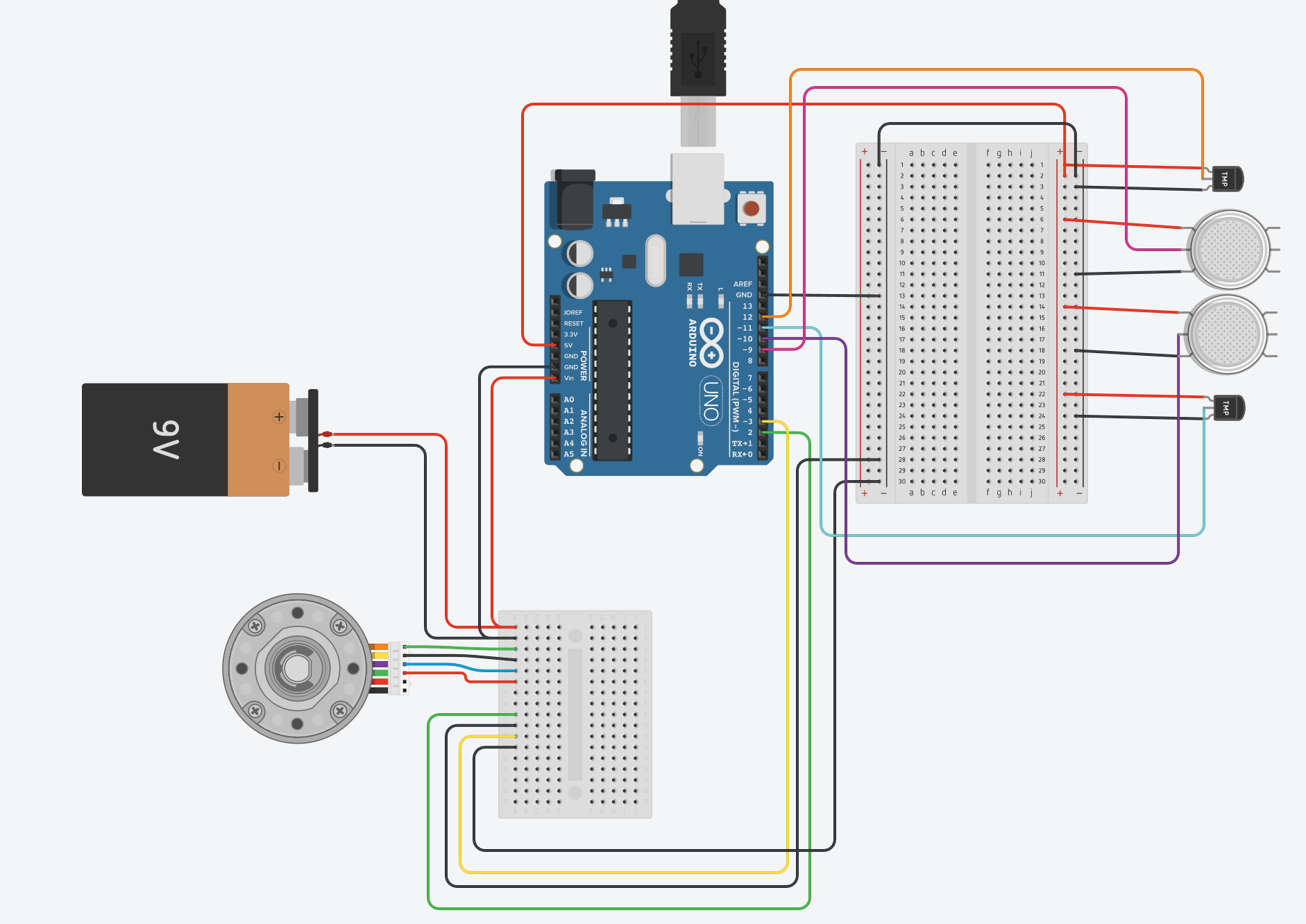
Two resistance-based temperature sensors and two particulate matter sensors are wired to an Arduino Uno (our school's electronics department had Arduino kits available, which made it the practical choice). One set of sensors faces indoors, the other outdoors. The window opens when outdoor conditions are better than indoor; either the outside temperature is lower (passive cooling), or the outside air quality is better (ventilation). AQI takes priority over temperature, since exposure to poor air quality is more harmful than being in a suboptimal temperature. This means the window won't open on a cool day with wildfire smoke outside even if the temperature differential favors it, and it won't open on a hot day just because outdoor AQI is better.
The control logic uses a 3°F temperature differential threshold with a rolling average across 50 samples to filter sensor noise, and a 20 second reference update to prevent the window from hunting between open and closed as conditions change gradually. We arrived at these values through testing; too sensitive and the window would cycle constantly on minor fluctuations, too insensitive and it would miss useful ventilation opportunities.
I initially tested with a larger stepper motor but downsized to the NEMA 23 after bench testing showed it provided sufficient torque with lower power draw. I tuned the stepper to run at 2.7A with 800 step microstepping for quiet operation. I also tuned the motor torque so it can't overpower a hand caught in the window, which was an important safety consideration for any automated closing mechanism.
Frame & Assembly
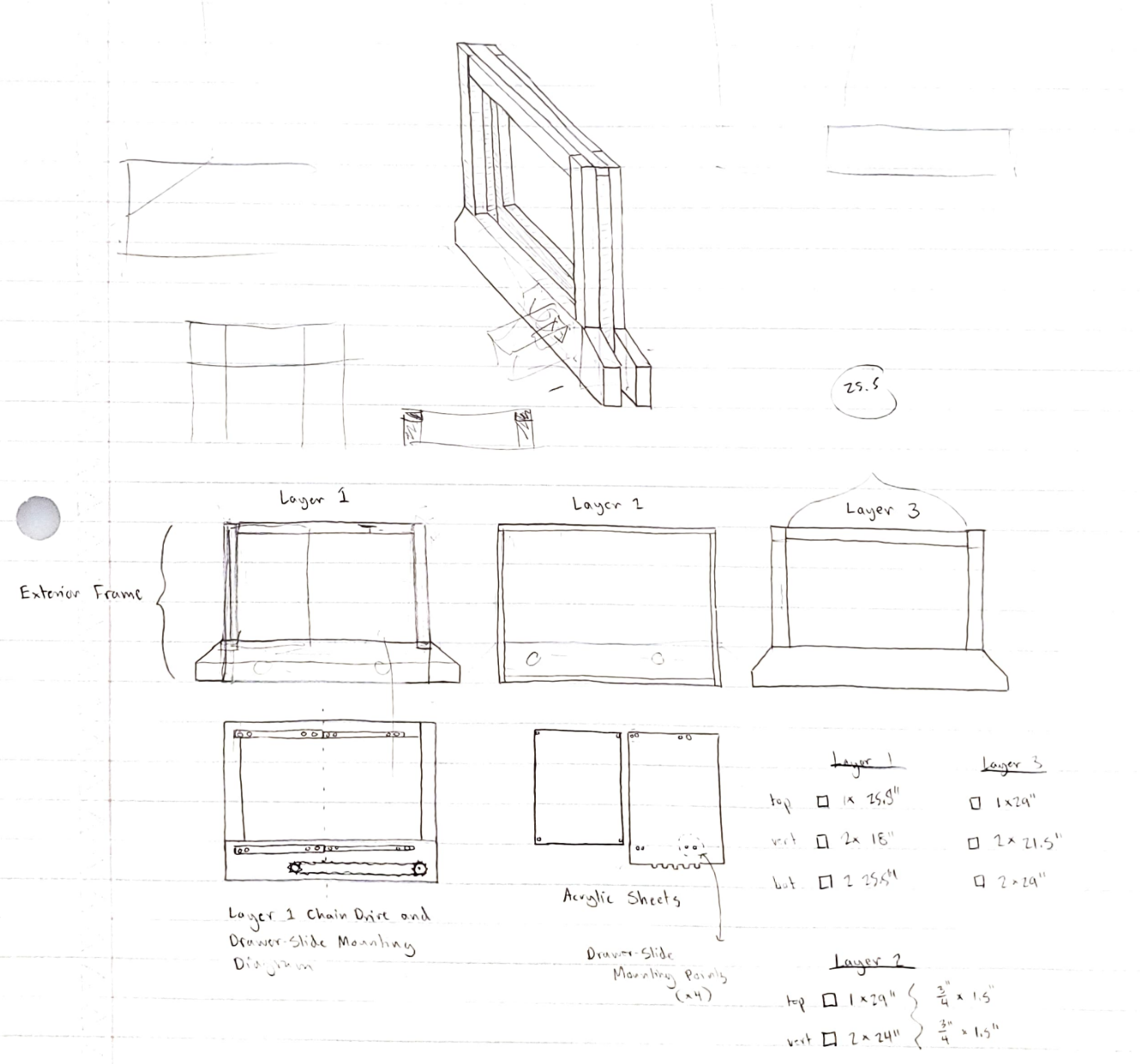
The frame is poplar, built in three layers: an exterior structural layer, a middle spacing layer that houses the chain mechanism, and an interior layer for mounting electronics. I milled half lap joints into both outer layers for strength; the spacing layer allows the drive system to be assembled independently before final integration. We cut everything else on a table saw and miter saw.
Acrylic window panes ride on standard drawer slides. Laser cut acrylic has a microscopically rough edge, and sliding it directly against the wood frame created too much friction for the motor to overcome reliably. Drawer slides solved this for the prototype; a production version would use a proper window channel instead. I housed the electronics in a clear acrylic enclosure to protect from dust while remaining accessible.
The hardest part of the build was integration. Getting the chain tension, motor torque, sensor thresholds, and frame tolerances all working together in one assembly was more difficult than getting any individual subsystem right.
Performance
At 20 cycles per day, the window consumes roughly 0.5 kWh annually, which is negligible compared to the ~2,500 kWh a typical residential HVAC draws.
The window responds within seconds to temperature changes; as you can see in the video, body heat from holding the sensor is enough to trigger actuation. We also verified this with a heat lamp as a more controlled heat source.
With a system of smart windows, residential HVAC could be cut significantly using a night flush cooling strategy: opening windows when outdoor temperatures drop at night to pre-cool the building mass, then closing them in the morning to retain that coolness through the day. Assuming ~40% cooling load reduction (reasonable in dry climates like Colorado where night flush is most effective) on a typical household's ~2,500 kWh annual AC consumption, that's roughly 1,000 kWh and $200+ in savings per year at average electricity rates. Scaled across a building, the compounding effect on HVAC load is substantial.
We presented the working prototype at the CU Boulder Engineering Exposition, where a panel of faculty and industry professionals reviewed over 200 projects and awarded recognition in about five categories. Ours won Most Impactful. If I rebuilt this, I would integrate the electronics inside the frame with a custom PCB to shrink the control system down, and build a housing meant to fit an actual window rather than the standalone test assembly we prototyped on.